




Posts Tagged ‘Andrea Tomkins’

living
family
media

Hyper Parents & Coddled Kids


Did you catch this CBC documentary yesterday?

I got a heads-up from Ann Douglas’ blog at parentcentral.ca that it was coming and I was intrigued. In her review, Douglas concludes that this “hyper-parenting” phenomenon is largely a thing of the past:

The documentary is worth watching, if only as a reminder of where we’ve been and how far we’ve come in rejecting the consumerist parenting style that views parents as manufacturers and kids as products to be paraded before the neighbors and the relatives.

I’m not so sure, though. I think hyper-parenting is still highly pervasive in one form or another.

As example, I know a college professor who refuses to take calls from the parents of students — he finds it utterly ludicrous that he would need to speak to the parent of an adult. But apparently a lot of the parents don’t think so, because it keeps happening year after year.

I also know a senior high-school teacher who, although he loves his job, does admit to the frustration of dealing with “enabled” students and their parents. If a student, as example, does not hand-in their assignment and as a result is not allowed to progress to the next task, he can expect a parent call. And when the parent doesn’t get what they want from speaking to the teacher, they’ll move on up to the vice-principal. In a school system that barely allows students to be held accountable for their actions, parents like this only seem to compound the issue.

How these same young people will ever live as independent adults is anyone’s guess. Which is why the documentary was particularly fascinating when it focused on young adults that were not long out of the nest. Some were university students hobbled by anxiety. And then there was one young woman who seemed to epitomize the issue perfectly. She was bright, but seemingly clueless when it came to “real life” smarts. She cited being let go from a number of jobs due to attitude, lateness and disrespect for senior colleagues.

At the point when the documentary catches her, she’d chosen to leave a job that paid 90,000/year to start her own business. The business never took off and we see her prancing into an office to discuss bankruptcy with a designer bag, takeaway coffee and iPhone phone in hand. And what will happen to this helpless creature? Oh, mommy and daddy will surely take her back in. They’ve already been subsidizing her rent, after all.

Perhaps when Douglas suggests that hyper-parenting is no longer a common practice, she’s referring more to the over-indulgence of consumer goods upon children — the latest toys, video games and designer clothes — as grossly demonstrated in the documentary’s coverage of a $4,000 birthday party for a one-year-old. But even in this regard, I’m not so sure it’s a done deal either.

The documentary notes that hyper-parenting is found in the middle- to upper-classes. I live in a middle- to upper-class neighbourhood and I can attest that consumerism is still rampant in this neck of the woods! Kids wearing Lululemon, toting Nintendo DS players, heading out to multiple extra-curricular activities a week and returning home to their McMansions. Sure, it’s not everyone, but there’s enough to safely say that it exists.    

So, if this hyper-parenting does in fact exist in strong numbers, am I one of them? I don’t think so. But sometimes I actually have this irrational urge to be one.

What do I mean by that? Well, the documentary points to two driving factors behind hyper-parenting: fear (as suggested by the author Carl Honore) and peer pressure (as suggested by one of the parents).

Like all parents, I’m vulnerable to any suggestions of harm to my children. This innate desire to protect our children is used to sell newspapers, magazines, products and services everyday.

How? Okay, here’s one example: headlines shouting out that a child has been abducted by a stranger. It’s not that the media shouldn’t report on this — it is news, after all. It’s just that my intense desire to protect my child can overshadow the hard facts that stranger abductions are exceedingly rare. This parental fear is why few children ever walk to school or their bus stop unsupervised.

And despite my best efforts to shed this fear, I am one of those parents whose children are rarely unsupervised. So what’s the harm in this? The documentary draws a few interesting connections. The first is that when one isn’t allowed unsupervised play, then one ends up with structured play — like a team sport. Honore points out that team sports take all the control away from the child because the rules are made for them, the referree decides who is playing by the rules, etc. The documentary also points out that once you’ve been hovering around your child long enough, it starts to seem natural. Both parents and child get used to always having each other around and a co-dependence develops which makes eventual independence less likely.

The other driving factor that I mentioned above was peer pressure. As much as I hate to admit it, I feel the weight of peer pressure … that so-and-so is taking this class, perhaps my child should too? I actually feel embarrassed to admit that my children are enrolled in exactly zero extra-curricular activities at the moment. Rationally, I know that my children are getting exercise and stimulation through the more unstructured things we do as a family. But I still have this irrational response to the peer pressure to conform to what others are doing. I guess when it comes right down to it, this peer pressure brings me back in a circular swing to fear. The fear that maybe so-and-so is doing the best thing for their child and that I am depriving my child of something very important.

So what have I got to conclude from all of this? I guess:
1. That hyper-parenting is harmful to children
2. That hyper-parenting is a form of parental instinct, but magnified to excess
3. That I am vulnerable to fear and peer pressure

Nothing too ground-breaking in that list, is there? But still, the issue is deeply fascinating to me.

It really got me thinking about a lot of things — especially how much I dislike the use of fear-mongering to sell products and services to parents. It’s used to sell everything from books, to “green” products, to electronics and technology. (It also got Andrea Tomkins thinking about a lot of things too, which you can read here.)

And it really got me wondering if I have the potential to be a hyper-parent. I’ve concluded that I probably have the potential, but I’m just too darn tired to bother!

If you missed this documentary, you can read about it and view video clips here.


living
media

Me and Mr. Mozart


My bloggy friend Andrea invited me out on a date to check out some Mozart. A night on the town is always welcome, but I was also really interested in this new orchestra performance format that the NAC has recently adopted.

Produced by the Chicago Symphony Orchestra, this  format is called “Beyond the Score: Classical Music Exposed.” It’s been extremely well received by Chicago audiences and naturally the NAC is looking to replicate some of this success.

Here’s how it works: In the first half, the context of the music is shared with the audience–its place in history, the artist’s life at that time–and interspersed with sections of the music performed. Then, after intermission, the audience returns and hears the music played in its entirety, without interruption and with the benefit of the knowledge they gained from the first half.

For a newcomer to classical music like myself, this seemed like the perfect way to get initiated. So Andrea and I arrived to the NAC, and we were welcomed by Jennifer Covert (aka the NAC’s cyber-marketing department). Jennifer is also trying out a new format for audiences too: Blogger Night.

What Blogger Night meant was that a number of Ottawa bloggers were given complimentary tickets to that night’s performance. In addition, we bloggers were able to share two complimentary tickets with our readers. For the evening itself, we were treated to a pre-show chat with the NAC Orchestra’s Artistic Planning Manager Daphne Burt. And then after the show, we were invited backstage to have a meet and greet with the show’s one and only actor, Ottawa local Pierre Brault (who was assisted by a narrator, CBC Radio’s Bill Richardson).

So, the show.

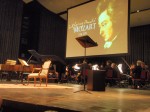
The Stage

We’re in great seats; the performance begins. I swear it wasn’t more than ten minutes into the show when I started to wonder if I had Adult ADD, or perhaps worse, I was just too superficial to “get” classical music.

And here’s why. I looked about me, I see others gazing attentively at the stage. They look utterly consumed with the content, the visuals, the music. But me? Here’s what my brain was doing:

Oh, this is interesting seeing Mozart as an actual person, not just a name attached to music. Hmm…did I eat dinner tonight? I’m a bit worried about that deadline, but I’ve still got two days, it should be fine. Stop worrying Julie. Gawd, did that woman bathe in her stinking perfume? Julie — FOCUS! Focus on the performance, darnit. Yes, I can hear that bit about the “rogue D flat.” That guy’s head is really flat on the top, it’s like a sideways flat-head syndrome. Uh, I seriously think I’m going to get a headache from that perfume. I wonder if Andrea is concentrating? Don’t look at her Julie! Look ahead. Huh, is that a man or a woman up there … hard to tell. The conductor is kinda sexy. Is that weird that I think the conductor is sexy? I wonder if the musicians think so? Wow, the women wore such beautiful dresses then. It’s nice to have these visuals. Perhaps it’s the power that makes him seem sexy? If I put my hand up against my face, I can smell my hand more than I can smell the perfume. That kind of works. My legs are getting stiff; these seats would be pretty small if you were a tall man. Julie, FOCUS! Okay, close your eyes, that might help. Oh yes, that helps …

In my original post on this event, I noted that I’m always more attracted to music with words rather than classical music. Now I know why. It’s because the words make my brain concentrate on them. When I listen to the words of the music, I don’t drift off to other thoughts. It’s the same thing for getting myself to sleep. To turn my brain off, I need to focus myself on the words in a book. Otherwise, my brain will ramble on and on.

But it really did make a difference when I closed my eyes. Oh, the music just flooded my senses when I did that! I felt carried away. That must be why people who love classical music really love it.

Backstage after the show

What a sensation, a release really. I want my children to be able to experience this. So I’m going to pick up some Mozart music–and whatever else I can find, for that matter–and play it around the house. Also, for my daughter, who’s seven and often finds it hard to get to sleep, I’m going to get her a portable CD player for her bedroom and let some classical music carry her off.

As for me, I think me and Mr. Mozart have made a connection. It’s not strong yet, but it holds promise.

P.S. If you’re already a classical music fan, you won’t want to miss Yo-Yo Ma and the rest of the interesing (from what I can tell!) line-up for this season at the NAC.

Related Posts Plugin for WordPress, Blogger...